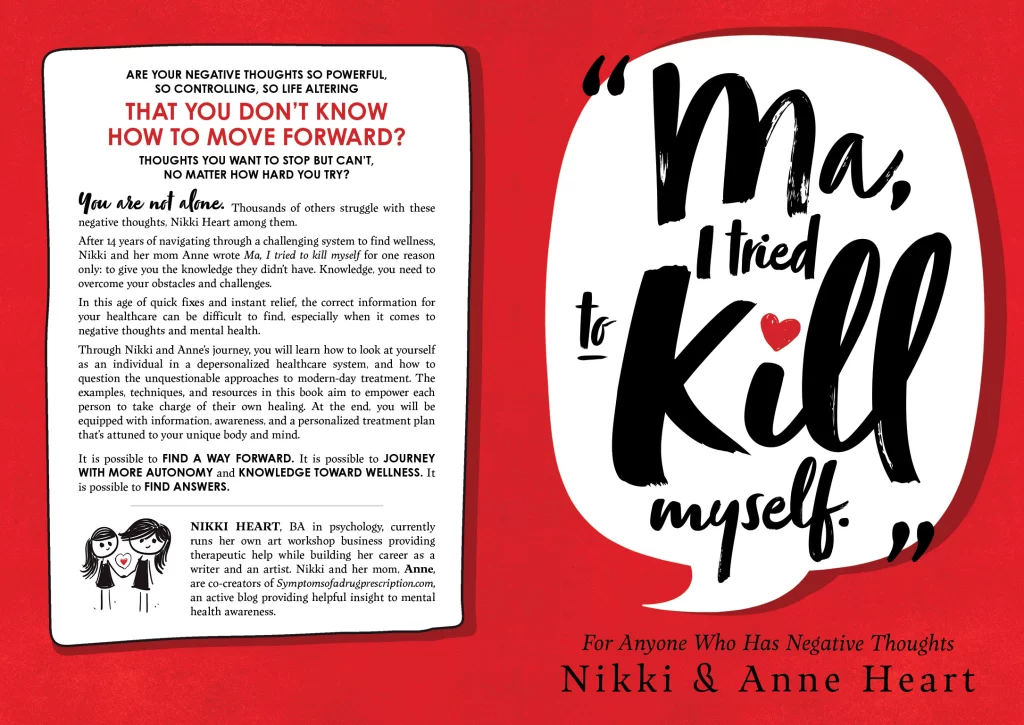
*Although we wrote this post together, we have chosen to present the following through Nikki’s eyes.
Nikki's Story: Journey through Zyprexa
By the summer of 2013, when I was prescribed Zyprexa, my physical and mental health was deteriorating.
Since changing to my current health care provider, Zyprexa was the fourth drug I tried as an addition to the three medications considered my “base.”
At that point, I was so discouraged and worn down that I was willing to try anything that might help. With Zyprexa being in a different class of medications I hadn’t tried before—atypical antipsychotics—I held onto the hope that maybe this time would be different.
Unfortunately, my medications were being changed so often that I lost any real sense of what each drug was supposed to do—or what side effects belonged to which one. To be honest, I don’t even remember being on Zyprexa at all. Most of my information from this time comes from our journals.
But what I do recall and one of the most troubling side effects I was experiencing at the time was the loss of comprehension. I couldn’t fully understand what was being said to me, let alone make informed decisions about my own care. Despite this, I was encouraged to attend appointments alone. My mom was often told to wait in the waiting room, even though I desperately needed someone who could help me process what was happening.
Thankfully, I kept communicating openly with my mom. With my information and her observance, she kept a detailed journal of every medication I was prescribed and the effects each one had on me.
According to her notes, I became sick shortly after starting Zyprexa. My dose was only 2.5 mg—the lowest available—but even that was too much for my already fragile system.
With no sign of improvement and complete unwellness, my provider discontinued Zyprexa after a short time.
For the next few months, I stayed on the same “base” medications, with only slight dosage adjustments. No new drugs were added, but none of the existing ones—despite years of poor results—were removed either. As the months passed, I continued reaching out for help, but my provider offered little in return.
Occasionally she mentioned cognitive programs I might qualify for, but she never followed through. When I brought them up, she would say my insurance wouldn’t cover them and the program would not accept me without insurance coverage. Meanwhile, my health continued to decline.
By 2014, she began adding new medications again.
More than a year had passed with no relief from the constant mental and physical pain. I finally decided it was time to find a new healthcare provider. But at my very first appointment with the new provider, more medications were added to the ones I was already taking.
Tips to Recognize
1. Understanding the Starting Point
I began prescription drug treatment in 2010, and by the time I was given Zyprexa in 2013, my physical and mental health had already deteriorated. Throughout those years, no one ever suggested withdrawing me from any of the medications I was already taking before adding a new one. Instead, I was repeatedly told these were my “base medications,” as if they were permanent fixtures rather than options that could be reassessed.
It’s important to pay attention to how you feel from the very first medication prescribed.
Do you feel worse mentally or physically?
Should the medication be continued, or is it time to consider something different?
If your symptoms keep worsening, is your diagnosis accurate?
Could the medication itself be contributing to your decline?
These are questions worth asking early—questions I wish someone had encouraged me to ask.
2. Recognizing When Symptoms Shift
From the beginning, the medications I was on intensified my depression, negative thoughts, and anxiety. On top of that, I developed a new layer of physical illness. I could no longer communicate the way I once did. My anxiety grew so severe that speaking to people—let alone speaking in front of an audience—became nearly impossible.
Activities I once loved, like roller coasters and movies, slowly slipped out of reach. I was told this was because my “mood disorder,” later labeled bipolar disorder, was worsening. But no one questioned whether the medications themselves might be contributing to the decline.
It helps to look at yourself from the very beginning of your treatment plan.
Are the changes you’re experiencing positive or negative?
Are you able to recognize these changes on your own?
If not, is there someone you trust who can help you see what you may be missing?
Sometimes the people around us can identify shifts long before we can.
3. Understanding Withdrawal
When withdrawing from a medication, it can be incredibly difficult to recognize that what you’re experiencing is withdrawal.
Withdrawal symptoms can last far longer than what a healthcare provider may suggest.
Stopping a medication abruptly can cause severe symptoms.
Even when tapering according to guidelines, negative effects can still occur.
Awareness doesn’t eliminate the difficulty, but it can help you understand what your body is going through.
4. Remembering Individuality
We are all different—our bodies, our histories, our sensitivities. If your healthcare provider doesn’t treat you as an individual, it may be worth questioning the approach. Your treatment plan should reflect you, not a one-size-fits-all model.
Note: All information in “Nikki’s Story and Mom’s Story” are based on detail journals covering seven years of Nikki’s life on prescription drugs.
Medical Disclaimer: We share informational resources that are intended to help you with your self-care plan. We are not professionals. We write based on personal experience and personal research.
Nothing on this Website is intended to be taken as medical advice. The information provided on the Website is intended to encourage, not replace, direct patient-health professional relationships. Always consult with your doctor before altering your medications. Adding nutritional supplements may alter the effect of medication. Any medication changes should be done only after proper evaluation and under medical supervision.
General Disclaimer: This site contains links to other internet sites. We are not endorsing any products or services in these sites nor are we endorsing or did we approve information within these sites. Each site contains its own “Privacy Policy”,