Symptoms of a Drug Prescription


Learn More Live Healthier


JOURNEY VIA PRESCRIPTION DRUGS (PART 2)


by Nikki and Anne Heart ♥  July 9, 2026


mental health, drugs, t-2211182.jpg

*Although we wrote this post together, we have chosen to present the following through Mom’s eyes.

Mom's Story: Journey via Prescription Drugs (Part 2)

Even though it’s been years since my daughter, Nikki, withdrew from all the mental‑health medications she was prescribed, the impact of those drugs still lingers in her life. The negative effects didn’t disappear when the prescriptions stopped—they stayed with her, shaping her days in ways we never expected.

To this day, Nikki continues to experience symptoms we strongly believe are tied to the years she spent on antidepressants, anti‑epileptics, atypical antipsychotics, and anticonvulsant medications. Memory loss and difficulty concentrating remain two of the most persistent challenges, and they are ones we can clearly connect to her time on these drugs.

But the deepest repercussions go far beyond physical or cognitive symptoms. The real weight lies in how those medications affected Nikki’s life—and our family as a whole. They changed the course of her young adulthood, altered her sense of self, and left her navigating adulthood without the tools to prepare her.

As I continue sharing our journey with prescription drugs, I want to offer information that may help you find your own path toward wellness. My hope is that by being open about what we’ve lived through, you’ll have the knowledge you need to make informed decisions for yourself or someone you love.

So now, I’ll pick up where I left off—with Step 3.

business, the next step, next-4241792.jpg
Step 3: Informed

While Nikki was being treated with prescription drugs after her suicide attempt, her diagnosis seemed to shift with every change of her medications. What started as an unspecified mood disorder, quickly became bipolar, then bipolar with depression, then rapid‑cycling bipolar with depression. With each label, came a new drug. With each drug, Nikki’s health deteriorated even more.

What we didn’t understand at the time was that many of the symptoms used to justify these new diagnoses were actually side effects of the very medications she was taking. Looking back, it’s painfully clear how much of her behavior, her energy, and even her personality was being shaped by the drugs themselves.

One thing I’ve learned, and something I want you to take seriously, is this: always check the potential side effects of any prescription drug you’re given. Not just once—regularly. Side effects, warnings, and even FDA guidance can change over time. What wasn’t listed years ago may be listed now. And what you’re told in a rushed appointment may not reflect the full picture.

Staying informed is not about distrust—it’s about protecting your health, your clarity, and your ability to make decisions that truly support your wellness.

bulb, businessman, drawing-2846032.jpg
Step 4: After effects

During Nikki’s years on prescription drugs, one of the hardest things for me as her mother was watching how differently she was treated—not just by her peers, but by the medical community itself. Time and time again, I saw doctors look at her as if everything she described was “in her head,” as if her symptoms were exaggerations instead of real, physical distress.

I’ll never forget the countless hours spent in emergency rooms, asking for help, only to be dismissed or ignored. Those moments stay with you. They change you.

What’s even more heartbreaking is that this treatment didn’t stop once she withdrew from the medications. Even afterward, her prescription drug history seemed to overshadow everything else. I watched doctors skim her chart and immediately jump to mental illness rather than considering other medical conditions. Her symptoms were brushed aside before anyone even took the time to truly listen.

It took Nikki seven endocrinologists—seven—to finally be diagnosed with Graves’ disease, despite the fact that her own father had been diagnosed years earlier. The signs were there. The family history was there. But the bias created by her prescription drug record was stronger than the evidence in front of them.

What we’ve learned through all of this is simple but essential: you must be persistent. If you feel something is medically wrong, do not stop pursuing answers. Not every diagnosis is straightforward. Not every condition presents neatly. And unfortunately, not every doctor looks past a patient’s history to see the full picture.

And always remember—side effects from prescription drugs don’t necessarily end when the medication does. Some can linger long after withdrawal, shaping your health in ways you may not expect.

Your voice matters. Your symptoms matter. And you deserve to be heard.

board, step, on each other-1273117.jpg
Step 5: Observe

Over the years, my family has learned to pay close attention to everything around us—to question, to observe, and to analyze the things most people overlook. Living with Nikki’s sensitivities has taught us that even everyday exposures can have unexpected effects.

One of the biggest realizations came when we noticed how certain foods could trigger an unusually elevated mood in Nikki. And as we learned the hard way, anything that spikes that quickly often crashes just as fast, leaving her feeling drained and unsettled. These patterns weren’t random—they were clues.

With the legalization of marijuana, avoiding the smell has become nearly impossible. For people with chemical sensitivities, that scent isn’t just unpleasant—it can be genuinely harmful. Nikki has had reactions ranging from an intense, sudden “high” sensation to full‑blown vomiting, all from secondhand exposure to the smell alone.

And it’s not just people. Animals can react too.

We personally know of a dog who became suddenly ill, and after ruling out every other possibility, the vet concluded the reaction was likely caused by exposure to a neighbor’s marijuana. Another example came from our own home—our dog once stuck his head into a salvia plant while trying to retrieve a toy. He ended up hallucinating for hours, with lingering effects that lasted for days.

I share these stories because animals don’t fake symptoms. They don’t exaggerate. They don’t anticipate outcomes. Their reactions are pure, unfiltered truth. When something affects them, it shows.

So it makes me wonder: if we trust the honesty of an animal’s reaction, why do we so often question or dismiss the reactions we see in people?

Our experiences have taught us to believe what we see, to trust our instincts, and to acknowledge that sensitivities—whether to chemicals, foods, or environmental triggers—are real. And they deserve to be taken seriously.


bulb, businessman, drawing-2846032.jpg
In summary, Nikki’s true diagnoses include:
  • Thyroid disease (Graves’ disease)

  • Obsessive‑compulsive disorder

  • Chemical sensitivities to bleach, perfumes, environmental odors, and other everyday exposures

  • Confirmed allergies to nickel, cobalt, balsam of Peru, and tree nuts

Each of these conditions contributed to years of pain, confusion, and unwellness—years in which her true medical picture was overshadowed, misunderstood, or overlooked.


Weekly Posts Every Thursday


DON’T FORGET TO VISIT OUR NEW TIP PAGES EVERY TUESDAY

  • Know any warning signs with a medication, even the rare or uncommon ones
  • Recognize changes in behavior when taking a medication. It doesn’t always happen right away
  • Be the eyes to someone close to you on prescription drugs
  • Learn all you can for yourself or for someone close to you
  • Remember question!
Related Posts
Journey through Wellness (Part 1)
Journey through Wellness (Part 2)
Journey through Wellness (Part 3)
Journey into Prescription Drugs

Drug Fact Sheets

Read more

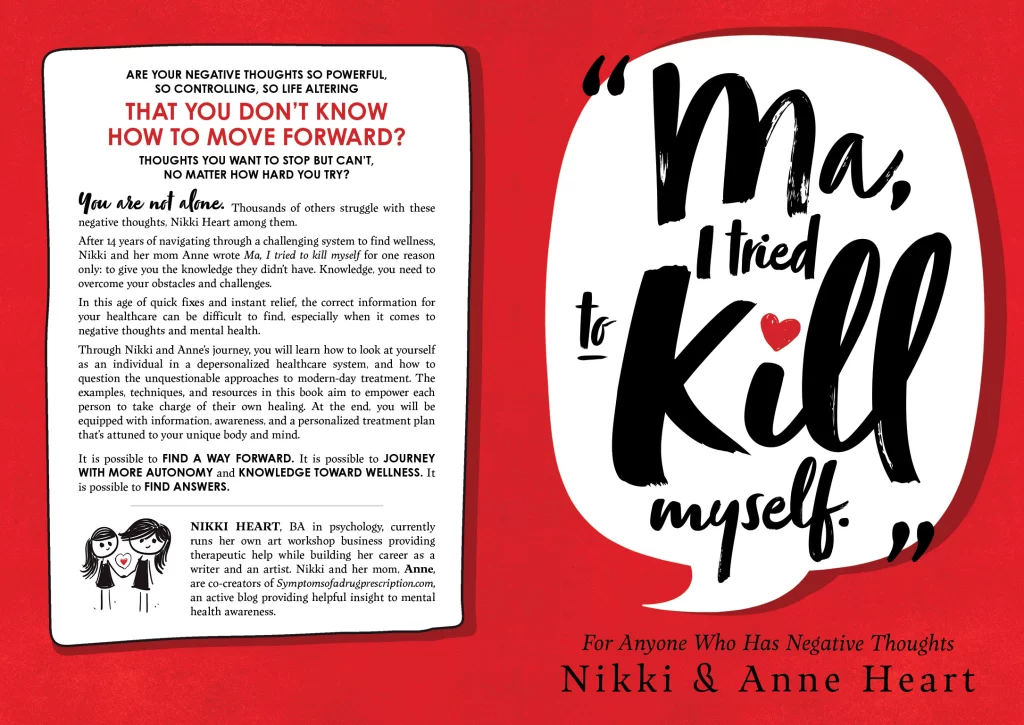
For Anyone Who Has Negative Thoughts

Our Debut Self-Help book

Now Available on Amazon

Note: All information in “Nikki’s Story and Mom’s Story” are based on detail journals covering seven years of Nikki’s life on prescription drugs.

Medical Disclaimer: We share informational resources that are intended to help you with your self-care plan. We are not professionals. We write based on personal experience and personal research.

Nothing on this Website is intended to be taken as medical advice. The information provided on the Website is intended to encourage, not replace, direct patient-health professional relationships. Always consult with your doctor before altering your medications. Adding nutritional supplements may alter the effect of medication. Any medication changes should be done only after proper evaluation and under medical supervision.

General Disclaimer: This site contains links to other internet sites. We are not endorsing any products or services in these sites nor are we endorsing or did we approve information within these sites. Each site contains its own “Privacy Policy”,

🤞 Want to level up your health this year?

Sign up for FREE weekly awareness posts. Never be without information again.

We don’t spam! Read more in our privacy policy