Symptoms of a Drug Prescription


Learn More Live Healthier


Moving Forward from Prescription Drugs (Part 2)


by Nikki and Anne Heart ♥  March 5, 2026


road, forest, fall-1072821.jpg

*Although we wrote this post together, we have chosen to present the following through Mom’s eyes.

Moving forward after a prescription drug treatment plan—as I mentioned in my previous post—can be incredibly challenging in ways you may not expect.

Prescription medications absolutely have their place, and for many people they play an important role in treatment. But I’ve learned how essential it is to understand the full range of effects, both the benefits and the drawbacks. It’s not just about what happens while you’re on the medication. It’s also about the aftereffects that can surface once the prescriptions stop.

As we continue this journey together, I want to shed light on some of the long‑term impacts that often go unspoken.

And I understand, deeply, that even when you’re ready to take your healthcare in a new direction, figuring out how to move forward can feel overwhelming. You’re not alone in that feeling. The path may be complicated, but awareness is the first step toward reclaiming your wellbeing.

drive, road, travel-843075.jpg

Discovering Through Our Journey

As I shared in my previous story, Nikki’s withdrawal from prescription drugs opened the door to understanding several long‑term negative effects that we hadn’t fully recognized while she was still on them.

These aftereffects revealed themselves slowly but unmistakably—an overwhelming sense of lost time, the painful awareness that she had lived for years as someone other than her true self, and the emergence of cravings she never had before. Each realization carried its own weight, its own grief, and its own lessons about what long‑term prescription drug use can leave behind.

Continuing from my story, Moving Forward from Prescription Drugs – Part 1, I want to shed light on additional effects to be aware of.

end, rails, train-588614.jpg

Awareness to Long-term Negative Effects 

Awareness #4:  Inaccurate Diagnosis

From the very beginning, when Nikki first reached out for help with depression, she was immediately labeled with a mood disorder and placed on prescription drugs as her primary treatment plan. Over the years, that initial diagnosis shifted repeatedly—from an unspecified mood disorder to various forms of bipolar disorder and eventually to other mental health conditions. Each new label brought new medications, yet none addressed what was actually happening in her body.

Throughout this time, I consistently voiced my concerns to her healthcare practitioners. Nikki showed clear, textbook signs of obsessive‑compulsive disorder (OCD), and she had always been extremely sensitive to medications and chemicals. Still, neither of these factors were meaningfully considered in her treatment plan.

It wasn’t until after she withdrew from the prescription drugs that the truth finally surfaced. Nikki was properly diagnosed with hyperthyroidism and a glutamate imbalance. Soon after, her long‑overlooked OCD was finally acknowledged.

Why does an inaccurate diagnosis become a long‑term negative effect?

Because when the diagnosis is wrong, the real issues remain untreated. Underlying conditions can worsen, creating a cascade of complications that follow a person for years.

In Nikki’s case, this became painfully clear during her struggle with Graves’ disease. Diagnosing thyroid disease should be straightforward, and obtaining proper treatment should not be difficult. But for Nikki, it was neither. Her history with prescription drugs caused many doctors to hesitate. They viewed her through the lens of mental illness, assuming her sensitivities from the thyroid medications were exaggerated and dismissed them.

It took more than two years and seven endocrinologists before Nikki’s thyroid condition was even somewhat stabilized. That delay alone became a long‑term consequence of her earlier misdiagnosis.

But the most significant impact of all has been the effect on her OCD. Years of inappropriate prescription medications that often intensified her symptoms, has led to difficulties Nikki now faces in managing her OCD.  

An inaccurate diagnosis doesn’t just delay healing—it can fundamentally alter the path of a person’s life.

Consequence #4: Difficulty Obtaining Adequate Health Care

change, nature, arrows-948024.jpg
Awareness #5:  Change in body and mind

Watching my daughter change—physically and mentally—throughout her prescription drug treatment plan was heartbreaking. What saddens me even more is how those changes continue to affect her today.

Nikki works tirelessly to rebuild her physical health. She follows a strict diet of organic, non‑GMO, gluten‑free foods and maintains a consistent exercise routine. Yet the fear of weight gain still lingers, a shadow left behind by years of medication‑related changes.

Mentally, she continues to struggle with memory issues and cognitive challenges she never had before—or that were significantly worsened by the medications. Whether her memory and thinking will ever fully return to what they once were is something no one can answer.

So, we focus on what we can control. We live in the present, with the intention of shaping a future that is healthier, happier, and grounded in truth rather than misdiagnosis.

Consequence #5: The Body and Mind Are Altered

knowledge, curiosity, confusion-3255140.jpg
To summarize, there are several potential long-term negative effects that may surface after a prescription drug treatment plan. These can include:
  • Loss of time
  • Trust Issues
  • Drug cravings
  • Alcohol dependence
  • Weight-related challenges
  • Memory loss
  • Ongoing confusion
  • Difficulty obtaining adequate health care 
  • Lasting changes to both body and mind 
And through all of this, it’s important to hold on to a few essential truths:
  • You are not at fault.
  • You are not alone.
  • You can only do what is possible in each moment.
  • And above all—you are still YOU.
Most importantly…
  • Question what you feel is not accurate.
  • Learn all you can about your treatment plan.
  • Help others that need your help.
  • Recognize that the health care provider may be wrong.

Learn More

Live Healthier

Weekly Posts Every Thursday


DON’T FORGET TO VISIT OUR NEW TIP PAGES EVERY TUESDAY

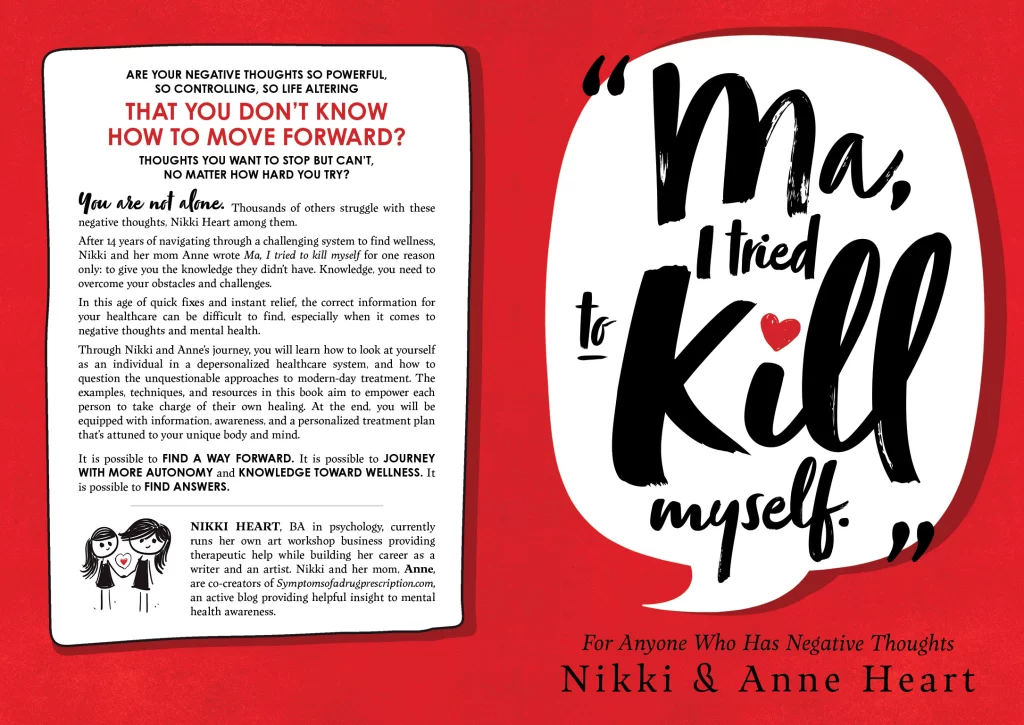
For Anyone Who Has Negative Thoughts

Our Debut Self-Help book

Now Available on Amazon

Weekly Quote
“A question that sometimes drives me hazy-am I or are the other crazy?”


– Albert Einstein –

Drug Fact Sheets

Read more

Note: All information in “Nikki’s Story and Mom’s Story” are based on detail journals covering seven years of Nikki’s life on prescription drugs.

Medical Disclaimer: We share informational resources that are intended to help you with your self-care plan. We are not professionals. We write based on personal experience and personal research.

Nothing on this Website is intended to be taken as medical advice. The information provided on the Website is intended to encourage, not replace, direct patient-health professional relationships. Always consult with your doctor before altering your medications. Adding nutritional supplements may alter the effect of medication. Any medication changes should be done only after proper evaluation and under medical supervision.

General Disclaimer: This site contains links to other internet sites. We are not endorsing any products or services in these sites nor are we endorsing or did we approve information within these sites. Each site contains its own “Privacy Policy”,

🤞 Want to level up your health this year?

Sign up for FREE weekly awareness posts. Never be without information again.

We don’t spam! Read more in our privacy policy